
Readers, this week I had the dubious pleasure of sitting in on a presentation given by the chocolate company Equal Exchange to an audience of prospective investors. It was certainly a strange experience for me. Rugged investigative journalist and travel memoirist that I am, I’m more used to the dusty backroads and smoggy back alleys of this wide world of ours than its gleaming hotel event spaces. But a close friend of mine is friends with someone whose father is in the chocolate business, and as we made our long trek back to Cincinnati from Juarez in the back of that old pickup (see previous blog entry), we got to talking.
He told me about a new business model in the industry, based on farmer cooperatives in Latin America, where the farmers are paid fairly and customers know where their chocolate came from, and can eat in good conscience. At first I was as excited as I was skeptical. The details were vague and we still hadn’t gotten new phones, so I couldn’t dig in right away. But this flew directly in the face of everything I knew about chocolate production. Latin America instead of West Africa? Fair wages? How did they stay in business? I wanted to know more, so as soon as we got stateside I took him up on the offer to attend the aforementioned presentation (whose accompanying materials you can find here). Then, I did a little digging of my own. Here’s my thoughts.
I won’t retread what you can already learn from the company’s own materials (see link above). In fact, I’m not even going to try and argue with them. I haven’t been to the Apurimac valley in many years, well before they got their operation up and running, and I can’t take time out of my current project to go speak to the farmers in person any time soon. But luckily, all the information I need to make my point can be made even if all of Equal Exchange’s claims are true (and I doubt they are). Because it’s not about what they’re saying; it’s about what they’re NOT saying.
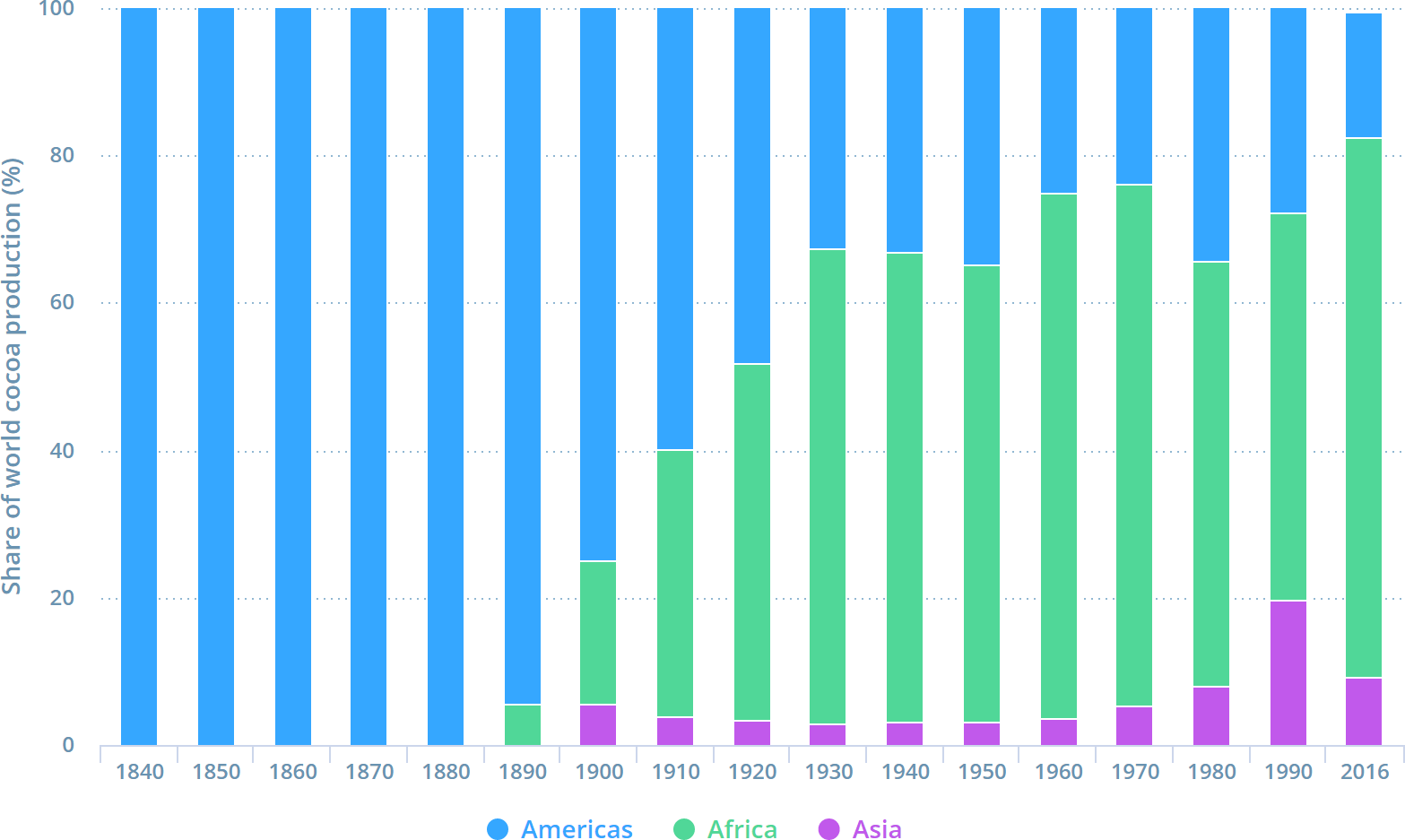
As I mentioned above, the chocolate trade is notoriously exploitative, and has been from the beginning. It was one of the first hallmarks of the colonization of the Americas, becoming a major fad for aristocrats, prized as an exotic product of the strange new lands being brutally subjugated for the sake of primitive accumulation to fuel the nascent capitalism of the Mediterranean (de la Fuente de Moral; for more on the this, my late personal friend Hugo Chávez recommends Galeano’s ‘Open Veins of Latin America’). However, at the turn of the century, a shift took place. After the conference of Berlin, European capital realized it could find even cheaper labor (and unspoiled farmland ripe for overexploitation) in West Africa.
source:https://www.winton.com/longer-view/cocoas-bittersweet-bounty
As the chart shows, over the course of the next several decades chocolate production relocated to this region almost completely. Today, just two West African countries produce around 60% of the world’s cocoa, receiving only around 5% of the $100 billion industry, with West African small-holder farmers in general accounting for 70% of global production (Boakye; Wessel, and Quist-Wessel). Labor laws in these countries are generally very weak, child labor is rampant, and wages are extremely low. “A joint study conducted by the French Development Agency and Barry Callebaut (the world’s largest cocoa producer) based on surveys conducted in Ivory Coast, found that farmers [on the ivory coast] earned an estimated 568 West African Franc, or $1 per day” (Sethi).
In many of these countries cocoa production is the backbone of the economy, particularly for the very poor, for whom it is essentially the only option for subsistence. And yet, as is the case in many colonial and neo-colonial arrangements (again, see Galeano for the Latin American Parallel), monoculture farming like that used in cocoa production tends to destroy soil viability over time. In the long run this greatly reduces yield and sends shockwaves through the local environment, along with deepening the dependency of the country through narrowing their capacity for domestic production.
But let’s pause. Equal Exchange wouldn’t dispute any of the above. In fact, some of their own materials lament this exact state of affairs. They present themselves as doing something different. And by all appearances they are! If their actual methods are even remotely close to what’s presented, their arrangements with local farmers, their workplace democracy, and their environmental impact are all stellar relative to the rest of the chocolate market. But this last part is the thread we need to pull. Because it’s not like capital’s relocation of chocolate production to West Africa from Latin America was simple greed. It wasn’t one person or company that did it, it was close to an entire industry that was transplanted.
The explanation is fairly simple. As we know from Marx (and as any capitalist will tell you), if a business isn’t competitive, if it’s not as profitable as its rivals, it will fold. It is commanded by the law of value to either increase productivity or starve. But it’s not the production of use-value that’s at stake here (or, rather, use-value is relevant only insofar as a market for chocolate must exist). Rather, it is the exchange-value that matters. In other words, the point is the maximization of profit, and the assurance of profitable re-investment.
If a business is less profitable than the others it’s in competition with, it’ll fold. And this profitability, Marx tells us, is fundamentally predicated on the exploitation of labor. Assuming a relatively standard level of technology across the industry (which we can, if we’re talking about a narrow time frame), this means that the definitive factor for maintaining profitability is the intensification of exploitation, including the lowering of wages. Along with these low wages, political vulnerability and material desperation are required to keep them low. Which brings us back our thread with a burning question: if the majority of the chocolate industry is so exploitative, and if Equal Exchange really is less exploitative, how have they not been driven out of business by their competitors? The answer is that the rest of the chocolate industry aren’t really their competitors.
Source: https://www.winton.com/longer-view/cocoas-bittersweet-bounty
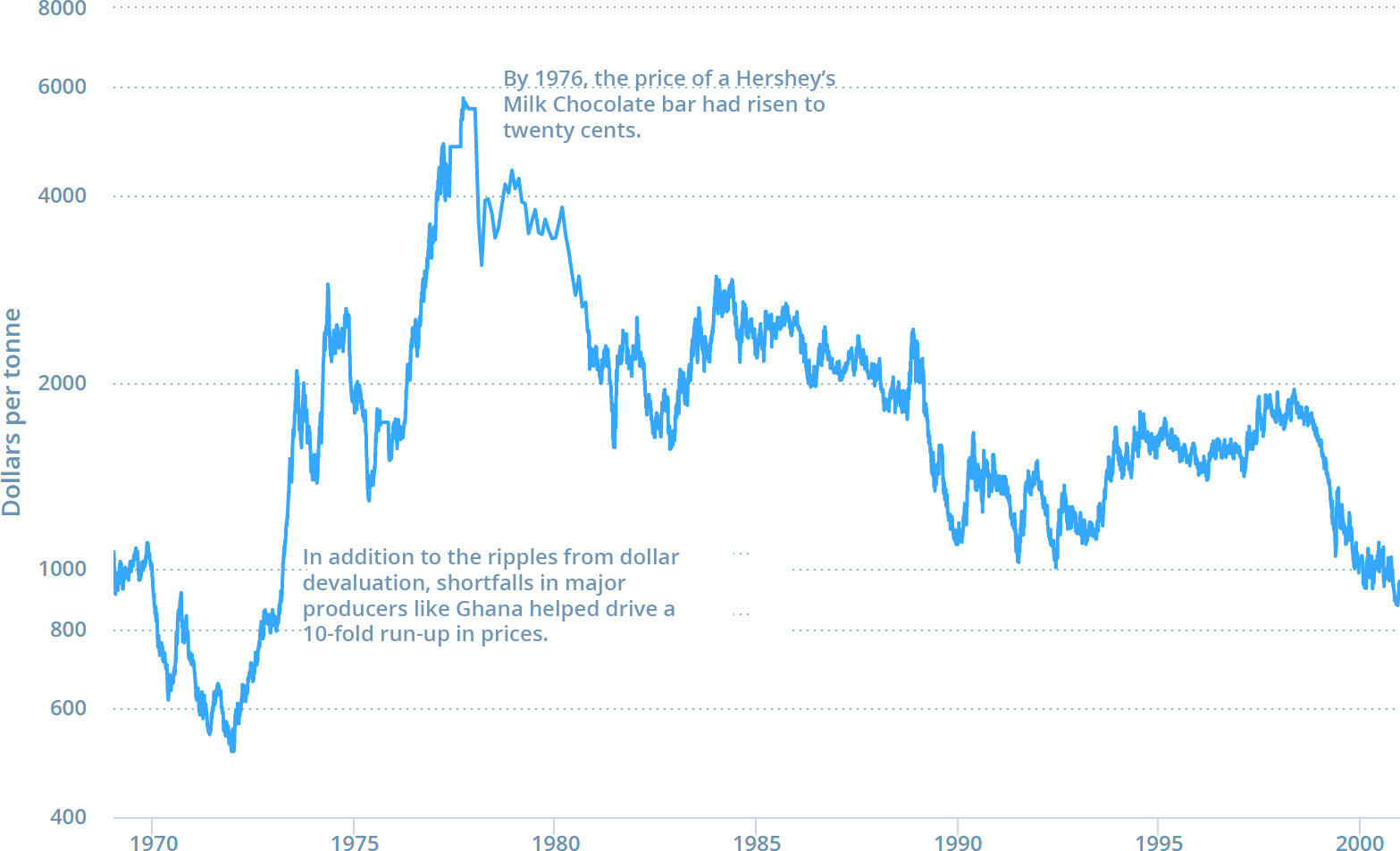
The shift to neoliberalism with the global crisis of the 1970s also saw a global spike in chocolate production (see figure). This has only accelerated in recent years, with the rise of industrializing nations like China and India (see David Harvey’s ‘A Brief History of Neoliberalism’). As these countries industrialize and their markets integrate more fully with those of the west, the so-called “American Diet” (prominently featuring sweets like chocolate) has tended to spread as well, increasing demand (Patel). These new markets are largely having such a diet semi-imposed on them by circumstance, and don’t have the luxury of worrying about where their heavily-processed food is coming from. But in the West, the story is different.
After the global revolts of the late sixties and the domestic youth movements that overlapped with and participated in them (particularly those centered on the Vietnam war), progressively-minded portions of the American middle and upper classes became increasingly aware of the plight of the third world (see Arrighi et al.’s ‘Anti-Systemic Movements’ for a more detailed account). But hippies turned to yippies and yippies turned to yuppies. These disillusioned former flower-children still carried with them some of the legacies of their youth, now channelled into a safe consumerism. I contend that it is this broad demographic of guilty-conscience managerial bourgeois, and the cultural niche they created, that companies like Equal Exchange seek to capitalize upon, as a subcategory of the luxury chocolates that appeal to the same class.
The luxury part is clear: Equal Exchange is a higher-end chocolate at up to $6.00 a bar, with Ghirardelli bars (for instance) going for about half that (prices vary, this is judging loosely on amazon prices). This increased price is, of course, what allows their model to remain profitable. But this isn’t enough to explain the Equal Exchange brand. It’s not JUST a luxury bar: the packaging plastered with platitudes and smiling farmers makes that clear. It’s not just higher quality chocolate this company is selling, it’s a clean conscience. They’re selling, to people at the top of the global hierarchy of labor (and thus the ability to afford it), the ability to say “I, personally, am not participating in this injustice I’ve been forced to be aware of, so I have done my part. I am not responsible.”
Equal Exchange presents itself as an alternative model of production, but its entire existence is premised on it being an exception to a general condition of the most brutal oppression and IN-equality. It can only afford to operate as it does if it can charge luxury prices, which it can only do if there are people willing and inclined to buy luxury chocolate, and the existence of a class of such people is predicated on the exact global network of exploitation (capitalist-imperialism, the global division of labor) that the company claims to abhor. In selling guilt-relief and chocolate as a package deal, it serves to make those that profit from the current system morally comfortable, and to obfuscate its true nature. In this way, whether it realizes it or not, it’s simply a subtle internalization of the costs traditionally associated with charity and philanthropy (albeit on a much smaller scale). I’ll let Engels have the last word on that:
“The . . . bourgeoisie is charitable out of self-interest; it gives nothing outright, but regards its gifts as a business matter, makes a bargain with the poor, saying: “If I spend this much upon benevolent institutions, I thereby purchase the right not to be troubled any further, and you are bound thereby to stay in your dusky holes and not to irritate my tender nerves by exposing your misery. You shall despair as before, but you shall despair unseen, this I require, this I purchase with my subscription of twenty pounds for the infirmary!”
 Backroads and Back Alleys with Ed Blaze